


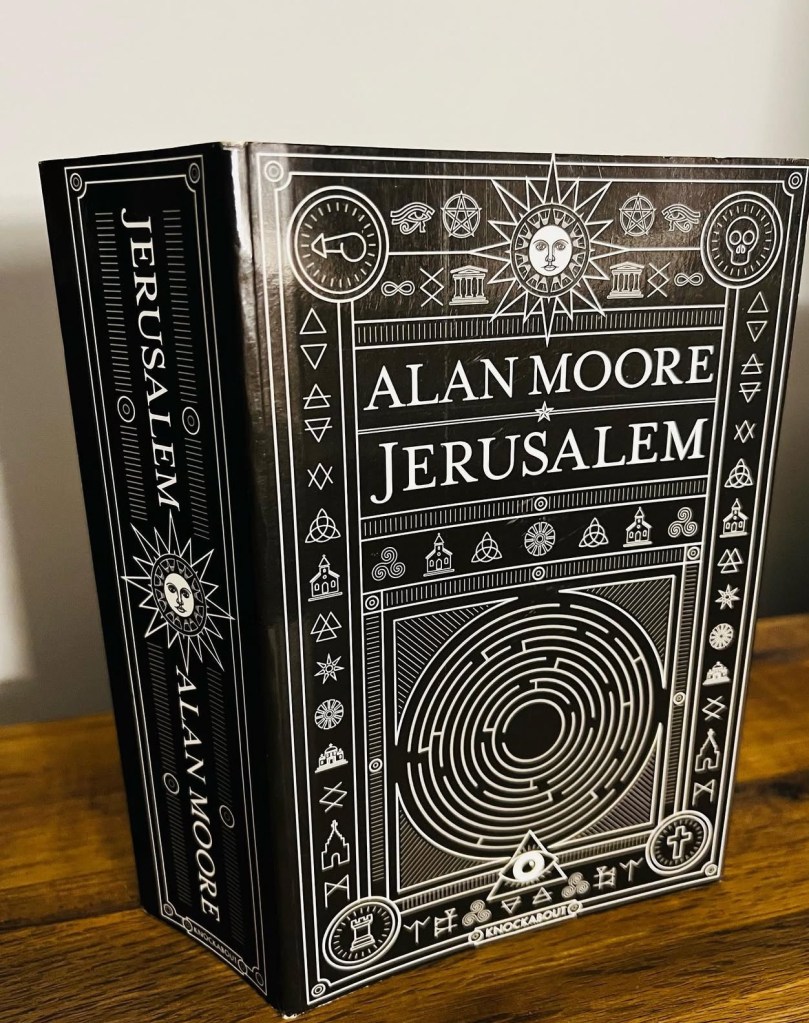
Jerusalem by Alan Moore….reading this can be an overwhelming undertaking but is it worth the effort?
Alan Moore’s magnum opus is a huge, non-linear narrative blending stories from the medieval times to the present and set in and around his hometown of Northampton, England—a town Moore parallels with Jerusalem. For those of us who have been to Northampton this would, on the face of it, seem a reach. But this is the first lesson to be learned from this book: do not approach it as you would any other because it isn’t like any other book and what does become clear is that it is, amongst many other things an open love letter to Moore’s home and the sense of his connection to it palpable.
Moore divided the book into three sections, The Borough’s, Mansoul and Vernall’s Inquest, each exploring different dimensions of time and space, with characters that recur across centuries, echoing each other’s lives in a narrative that comes deep from within the author’s perspective of the spirit of time and place and the memory of its ancestors deeply etched into the walls of its history.
We are given a town-size cast, both living and dead, real and fictional. One of my favourites was Alma Warren, an artist grappling with her family’s history, and her brother Mick, whose journey into the afterlife forms one of the book’s central narratives. Moore’s characters are deeply human, flawed, yet imbued with a sense of the mystical or divine, reflecting his theme of the sacredness of ordinary life.

At its core, “Jerusalem” is about the sanctity of place and time. Moore explores themes of art, madness, and the nature of reality itself. He delves deep into the town’s history, its people, and that notion that every city has multiple layers of stories, much like Jerusalem in the biblical sense.
Moore’s prose is dense, often poetic and very definitely Alan Moore. If you have heard Moore speak, especially about Northampton then you can hear his voice echoing off the pages, this is his story told like the Bards of old, his knowledge of the town’s history and its inhabitants from the ‘lifers’ to famous visitors is remarkable and vital to the construction of this epic book. Moore’s understanding of real dialogue is second to none, so often, authors give their characters a kind of speak that is impossible to take seriously (latter day Le Carré being a prime example) but with Moore you have an author who lives and breathes the working class and their environs and it shines throughout the book.
At over 1,200 pages it can feel daunting, but I saw it as less of a novel and more of an oratory of history told in the best Bardic tradition. If you treat Moore like any other mainstream author then this book is unlikely to work for you. Yes, it’s long and yes, there are parts which could be edited out but the essence of the story is in the detail. Moore provides detail which may or may not prove significant in the way we, as everyday storytellers explain our own experiences. Each of these scraps of information are part of the tapestry of life and the history of place, memory and that eternal city of ours. For Moore, Jerusalem is Northampton but for the reader it could be anywhere and therein lies, for me, its unique charm. If nothing else, it makes you realise the staggering, rich history of where we live and the memory of the footprints of those who went before us.
Categories: British History and Folklore, The Reading Room


 retroculturati