
I was reminded of The Angry Brigade having recently watched an old World in Action documentary on them from the mid 70s. The Angry Brigade was a small urban militant group active in England in the early 1970s who became infamous for some twenty five bombings of their perceived symbols of capitalism and state power.
The group formed in 1970, Britain, at that time was entrenched in anti-war protests, labour strikes, and a radical left-wing agenda influenced by groups and events across Europe. The most notorious of these groups which influenced the Angry Brigade were Baader Meinhof and The Red Brigade both of whom were far more organised and professional.
Whilst they claimed to have no desire to cause deaths of innocents, their bombs were placed in such a position that could only risk that. Government buildings, banks and the homes of prominent politicians such as the then Home Secretary, Robert Carr were usually notified beforehand but significant damage and risk to life were considerable.
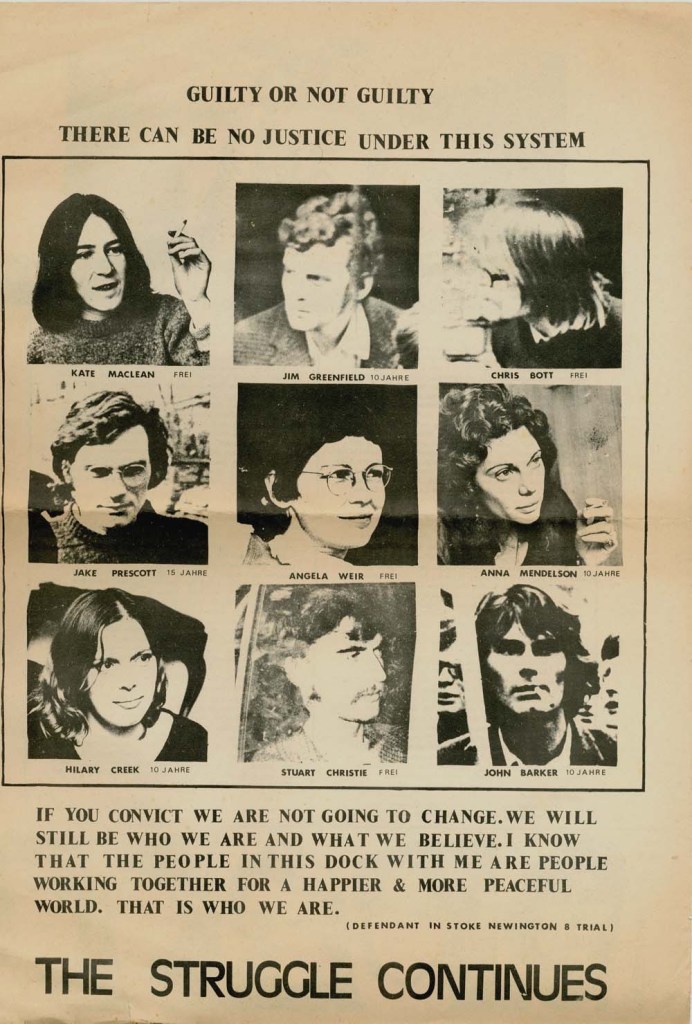
Ian Purdie and Jake Prescott, having met in prison became associated with the group via a commune in Islington. Purdie had been convicted for throwing a petrol bomb at an army recruitment centre and Prescott, a known burglar convicted for weapons possession became close friends with their radical views growing during their incarceration and Edward Heath’s government quickly became one of their main targets. By the end of 1971 Prescott was given a fifteen year sentence.
By 1971, the Police had arrested several suspects following a surveillance operation in both England and France. This would lead to the so-called Stoke Newington Eight Trial, at that time, one of the longest criminal trials in British history. Only four of accused were convicted and given sentences of up to ten years. The World in Action programme interviewed two of the women from the group who were out on bail and awaiting sentencing. Only one, Anna Mendleson, spoke at length and it felt as though the reality of a custodial sentence was being realised. Like so many of their generation, they saw a brighter future fuelled by anarchy and a destruction of the political system and radical politics never reached those heights of the 70s again.
The programme left me curious as to how time, and in some cases, prison would change the members of the group. Would their politics remain as resolute and passionate as it was fifty years ago? Well, to an extent it seems to have done, Mendleson opted for a quieter life and wrote poetry under an alias. Angela Weir would go on to be awarded an OBE, with the others settling into anonymity.
Was it all worth it? We can but guess.
Categories: British History and Folklore, Reportage


And Tony Swash got nicked for putting a petrol bomb through the letter box of Hampstead Library. Got 18 months
LikeLiked by 1 person